
Dinamica Limbajelor de Specialitate
Tehnici şi strategii inovatoare
Invitați speciali

;
Mihai Iacob (1968, Deva, Romania) is an Associate Professor within the Department of Romance, Classical and Modern Greek Languages and Literatures at the University of Bucharest, a position he has held since 1993. He holds a BA in Romanian and Spanish Language and Literature from the Faculty of Letters of the same university (1993), and he completed his PhD in Philology in 2002, presenting a dissertation titled “Cantigas de Santa María” de Alfonso X, el Sabio. His research interests include contemporary and current Spanish literature, translation studies, rhetoric, and author studies. Among his published works are: Cărtărescu. Ala izquierda. Autoimagen de Mircea Cărtărescu en España (1993–2018) (2023), “El ethos federado de Mircea Cărtărescu en la literatura española (2010–2018)” (2021), “La écfrasis auto/docuficcional en Tu rostro mañana de Javier Marías” (2019), “Escribir la fotografía: ‘novedad’ y remediación de la performance fotográfica en la ficción de Agustín Fernández Mallo” (2019), “Ideología proyectiva y rasgos recesivos en los productos culturales de Agustín Fernández Mallo” (2018), “The Perception of Romanian Immigrants in Spain: The Case of the Hola, soy rumano Campaign” (2017), “Argumentando a través del peritexto: la edición de 1996 de El Capitán Alatriste” (2017), “The ‘Ontological Indeterminacy’ in Comics: El Resentido by Juaco Vizuete” (2015), “The (Re)Construction of Transylvania in Vampire Films” (2013), and “La indistinción ontológica del discurso erótico: Coños de Juan Manuel de Prada” (2013). Professor Iacob is a member of several research groups and professional associations, including British and Comparative Cultural Studies: Identities and Representation (BRICCS) at the University of the Balearic Islands; the Traducción y Paratraducción Research Group (T&P) at the University of Vigo; the Organización Iberoamericana de Retórica (OIR) at the University of Alicante; and Estudios de Traducción en el Ámbito Universitario at the Autonomous University of the State of Mexico.

Title of plenary speech:
Learning languages has always meant using technology. From radio to television to film to the internet, people the world over have used technology to learn and practice languages. The internet enabled the creation of a global community of students and educators, and has contributed to the survival and growth of minority and indigenous languages. Soon after ChatGPT entered the mainstream in late 2022, apps like Duolingo became AI powered, and in 2024, when OpenAI introduced voice mode, the world of language learning changed forever. Learners now have access to their own personal language tutor, with whom they can learn and practice at any time of the day or night. Generative AI is therefore changing the role of the educator, from being the sole source of authority to one of multiple presences in a learning community. What does this mean for language education? For educators, how do we design learning for a world where students learn, practice and speak with AIs? For students, what knowledge, skills and competencies do they need in a world where GenAI translates everything for them? For language tutors, what does this mean for how we teach and practice language skills? For translators, what does this shift mean for intercultural communication? In this keynote, Mairéad will outline what the new hybrid of human + AI means for the future of language education and invite you to consider the future of language education in a world where learning with AIs in intelligent communities is normal.
TITLUL PRELEGERII:
Castilian Refractions of the Figure and Works of Mircea Cărtărescu.
Invitați speciali
Kris Peeters is professor of text analysis, French culture and literature and Translation Studies at the University of Antwerp (Belgium). He coordinates the James Joyce in Translation Centre, is member of the TricS research group (Translation, interpreting and intercultural Studies) and ACDC (Antwerp Centre for Digital humanities and literary Criticism), the European Society for Translation Studies, the International James Joyce Foundation, and the James Joyce Italian Foundation. He is executive board member of the European Language Council (ELC), member of the steering committee of the Doctoral school in foreign languages and literatures of the Catholic University of the S. Heart in Milan, chief editor of Linguistica Antverpiensia New Series - Themes in Translation Studies, assistant editor of the European Journal of Language Policy, and editorial board member of Sustainable multilingualism. His research, at the intersection of Bakhtinian discourse theory (dialogism) and translation studies, focuses on multi- and heterolingualism in literary translation (in and between English, French, and Dutch), particularly in translations of James Joyce's works, on theory and poetics of retranslation, as well as on cross-cultural transfer and cross-linguistic mediation strategies in plurilingual communication. Together with colleagues from Warsaw, Faro, Kaunas, and Milano, he worked on a European project about teacher training in plurilingual competences, including mediation and cross-linguistic mediation. (APATCHE: http://www.apatche.eu/?page_id=67). Since 2024, he is coordinator of the Special Interest Group on AI in Translation and Interpreting of the ELC, which has recently published an open access reflection paper titled "AI for Translation and Interpreting. A Roadmap for Users and Policy Makers" (zenodo.org/records/17639236).

TITLE OF THE PLENARY ADDRESS:
GenAI and multilingualism: tech-solutionism and user agency
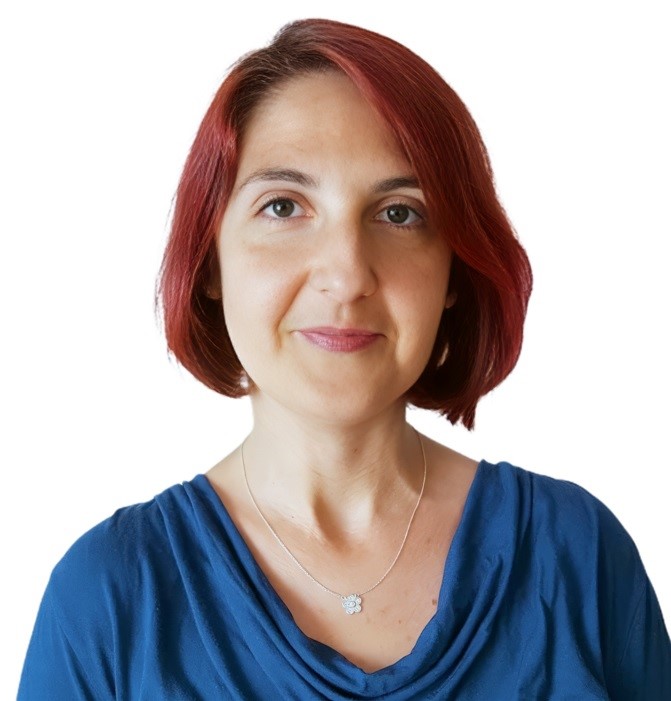
Teodora Naiba has been working in English language education since 1999, with a career that started in the classroom but has since grown to encompass a wide range of professional roles. As an international teacher trainer, material writer and online course moderator, she has collaborated with educators from diverse professional and cultural backgrounds, gaining a broad understanding of what teachers truly need. She is also an examiner for several examination boards, bringing additional insight into language assessment and standards. Her continuous interest in creative methodologies, life skills integration, and meaningful professional development drives her enthusiasm for exploring new directions in specialised language teaching alongside fellow practitioners.
Workshop Title: Navigating ESP:
Practical Tools, Fresh Perspectives, and Shared Experience
This workshop offers a space to critically examine current challenges and opportunities in ESP teaching, but it also creates a space where participants' own expertise and experience are central to the conversation. Through collaborative activities and reflective discussion, experienced ESP practitioners will exchange ideas, reflect on their practice, and explore adaptable tools and approaches that work across a wide range of contexts.